

London Breast Screening is part of the National Breast Screening Programme, providing a free breast screening service for women aged between 50-71 (first invitation issued by 53rd birthday), who are resident in London and West Hertfordshire.
If you have any concerns about changes to you breasts www.breastcancernow.org/information-support/have-i-got-breast-cancer/signs-symptoms-breast-cancer, please speak with your GP as soon as possible.
If you have breast pain, more information is available here www.rmpartners.nhs.uk/new-video-to-help-understand-breast-pain
Watch this information video on Breast Screenings here


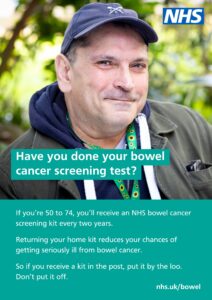
The NHS Bowel Cancer Screening Programme helps detect bowel cancer at an early stage, when treatment is often more successful.
Everyone aged 50 to 74 who is registered with a GP in England is automatically invited for bowel cancer screening every two years. A home testing kit is sent directly to you and can be completed in just a few minutes.
The screening test looks for tiny traces of blood in your poo that cannot usually be seen. Although it does not diagnose bowel cancer, it helps identify people who may need further investigations.
Most people who complete the screening test receive a normal result. If further tests are needed, it does not necessarily mean you have bowel cancer.
If you are 75 or over, you can still request a free screening kit every two years by calling the NHS Bowel Cancer Screening Helpline on 0800 707 6060.
If you think you are eligible for bowel cancer screening but you’ve not been invited or had your test kit, you can also call the bowel cancer screening helpline on 0800 707 6060
Symptoms of bowel cancer
Bowel cancer screening is for people who do not have symptoms.
If you notice any of the following symptoms, please contact your GP as soon as possible. EVEN IF YOU HAVE ALREADY HAD A NEGATIVE BOWEL CANCER SCREENING TEST:
- Blood in your poo or bleeding from your bottom
- A persistent change in your bowel habit
- Ongoing abdominal pain
- Unexplained weight loss
- Unusual tiredness
- A lump in your abdomen
Useful information
- South West London Bowel Cancer Screening Centre (St George’s Hospital)
- NHS information about bowel cancer
- Bowel Cancer UK
Easy Read Guide
Bowel cancer screening (GOV.UK website, PDF only, 2.65MB)
- Download the NHS App to get your future messages about bowel cancer screening straight to your smart
device.
- Find out more about bowel cancer screening on the NHS website.
The NHS Lung Cancer Screening Programme helps find lung cancer at an early stage, often before symptoms develop, when treatment is more likely to be successful.
Lung cancer screening is offered through the NHS Lung Health Check programme. People aged 55 to 74 who are current smokers or have smoked in the past may be invited for a free Lung Health Check. Invitations are sent automatically by the NHS to eligible patients as the programme continues to be rolled out across England.
A Lung Health Check assesses your risk of lung cancer. It usually begins with a telephone appointment to discuss your health and smoking history. If appropriate, you may be invited to have a CT scan of your lungs as part of the screening programme. Most people who attend a Lung Health Check will not have lung cancer. If further investigations are needed, it does not necessarily mean you have lung cancer.
Symptoms of lung cancer
Lung cancer screening is for people who do not have symptoms.
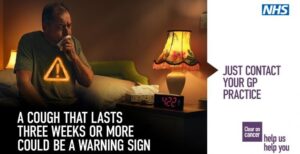
If you have had a cough for three weeks or more, please contact your GP practice. It is probably nothing serious, but it could be a sign of lung cancer. Finding cancer early makes it more treatable. Your NHS wants to see you.
You should also contact your GP practice if you experience any of the following symptoms:
- A cough that is getting worse
- Coughing up blood
- Persistent shortness of breath
- Chest pain or pain when breathing or coughing
- Repeated chest infections
- Unexplained weight loss
- Ongoing tiredness or lack of energy
- Loss of appetite
If you have any symptoms that could be a sign of lung cancer, do not wait for a lung cancer screening invitation. Please contact your GP practice as soon as possible.
For more information on cancer signs and symptoms go to nhs.uk/cancersymptoms
Smoking is the biggest cause of lung cancer. If you smoke, stopping is the best way to reduce your risk. Even if you have smoked for many years, quitting can improve your health and reduce your risk of developing lung cancer. Free NHS stop smoking support is available to help you quit.
Useful information
South West London Lung Cancer Services (St George’s Hospital)
NHS Lung Health Check
- Find out about the NHS Lung Cancer Screening Programme and Lung Health Checks
NHS information about lung cancer
Roy Castle Lung Cancer Foundation
Smoking support
- If you smoke, stopping is the best way to reduce your risk of lung cancer. Free NHS support to help you quit is available.
Download the NHS App
- Use the NHS App to view appointments, access your health information and receive messages from your GP practice.
Cervical Screening
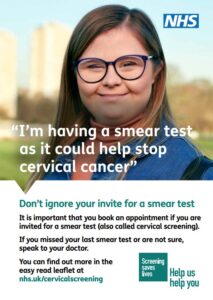
The NHS Cervical Screening Programme helps prevent cervical cancer by checking the health of your cervix. Screening looks for certain types of human papillomavirus (HPV), which can cause changes to the cells of the cervix over time.
Finding HPV early means that any abnormal cell changes can be monitored or treated before they have the chance to develop into cervical cancer.
Cervical screening is offered to women and anyone with a cervix aged 25 to 64.
You’ll usually be invited for screening every 5 years from the age of 25 to 64. You’ll receive your first invitation a few months before your 25th birthday.
You may be invited more regularly if HPV is found during screening.
If you’re 65 or older, you’ll usually only be invited if a recent test was abnormal or you have not been screened since the age of 50.
You’ll usually receive an invitation through the NHS App, by text or by letter explaining how to book your appointment.
What happens during cervical screening?
Cervical screening is a simple test carried out by a trained nurse or healthcare professional at your GP practice.
During the appointment, a small sample of cells is taken from your cervix using a soft brush. The sample is tested for high-risk HPV.
If HPV is not found, you’ll usually be invited for your next routine screening in 5 years.
If HPV is found, the sample is checked for any abnormal cell changes. Depending on the results, you may be invited for further tests.
Most people who attend cervical screening have normal results.
Symptoms of cervical cancer
Cervical screening is for people who do not have symptoms.
If you experience any of the following symptoms, please contact your GP practice as soon as possible:
- Unusual vaginal bleeding, including after sex, between periods or after the menopause
- Changes to your normal vaginal discharge
- Pain or discomfort during sex
- Persistent pain in your lower back, pelvis or lower abdomen
If you have any symptoms that could be a sign of cervical cancer, do not wait for your cervical screening invitation. Please contact your GP practice as soon as possible.
If you’re trans or non-binary
If you’re a trans man or are non-binary and have a cervix, how you’re invited depends on the sex you’re registered with at your GP surgery.
- If you’re registered as female with your GP, you’ll usually be invited for cervical screening automatically.
- If you’re registered as anything other than female, such as male or indeterminate, you may not receive invitations automatically. Speak to your GP surgery, sexual health service or transgender health clinic to ask about receiving cervical screening invitations.
If you’re a trans woman or are non-binary and do not have a cervix, you do not need cervical screening. However, if you’re registered with your GP as female, you may still receive invitations. If you no longer wish to receive them, contact your GP surgery, sexual health service or transgender health clinic.
Useful Information
South West London Cytology
Information about cervical cytology services in South West London.
https://www.swlpath.nhs.uk/home/what-we-do/departments-and-services/departments/cytology/
South West London ICB – Cervical Screening
Information about the importance of attending your cervical screening appointment.
NHS Cervical Screening
Find out about cervical screening, who is invited, what happens during your appointment and when you’ll receive your results.
https://www.nhs.uk/tests-and-treatments/cervical-screening/
NHS Cervical Cancer
Information about cervical cancer, including symptoms, diagnosis and treatment.
https://www.nhs.uk/conditions/cervical-cancer/
Cervical Screening Aware
Information and resources about cervical screening.
https://cervicalscreeningaware.co.uk/
Download the NHS App
Use the NHS App to receive screening invitations, book appointments, access your health information and receive messages from your GP practice.
Cancer Symptoms and When to Seek Help
It is important to know the signs and symptoms of cancer. Having these symptoms does not necessarily mean you have cancer, but if you notice something that is unusual for you, it is important to get it checked.
Worried about bowel cancer?
Bowel cancer can cause changes to your bowel habits and other symptoms that are unusual for you.
Symptoms of bowel cancer may include:
- changes in your poo, such as having softer poo, diarrhoea or constipation that is not usual for you
- needing to poo more or less often than is usual for you
- blood in your poo, which may look red or black
- bleeding from your bottom
- often feeling like you need to poo, even if you’ve just been to the toilet
- tummy pain
- a lump in your tummy
- bloating
- losing weight without trying
- feeling very tired or short of breath – these may be signs of anaemia, which can be caused by bowel cancer. Follow the link for symptoms and signs and what to do next. Please consult your GP if you have any of the signs and/or symptoms on the link. Please remember that even if you had a negative bowel screening test if you develop any of the symptoms on the link you should still consult your GP.
https://www.nhs.uk/conditions/bowel-cancer/symptoms/
Worried about cervical cancer?
Cervical cancer can cause changes such as unusual bleeding, discharge or pain.
Symptoms of cervical cancer include:
- vaginal bleeding that’s unusual for you – including bleeding during or after sex, between your periods or after the menopause, or having heavier periods than usual
- changes to your vaginal discharge
- pain during sex
- pain in your lower back, between your hip bones (pelvis), or in your lower tummy
If you have another condition like fibroids or endometriosis, you may get symptoms like these regularly.
You might find you get used to them. But it’s important to be checked by a GP if your symptoms change, get worse, or do not feel normal for you.
Follow the link for symptoms and signs and what to do next. Please consult your GP if you have any of the signs and/or symptoms on the link.
https://www.nhs.uk/conditions/cervical-cancer/symptoms/
Worried about Lung Cancer?
Lung cancer can cause symptoms such as a persistent cough, breathlessness or chest pain.
Common symptoms of lung cancer may include:
- a cough that is not going away
- shortness of breath
- coughing up blood
- chest or shoulder pain
- often having chest infections, or having a chest infection that is not getting better
- losing weight without trying
- not feeling hungry (loss of appetite)
- feeling tired all the time
Less common symptoms of lung cancer may include:
- swelling of your face or neck
- difficulty swallowing
- a hoarse voice that does not go away
- changes in the way your fingers look (clubbing) – your fingertips may look wider than usual or curve downwards.
You may not notice any symptoms in the early stages of lung cancer.
Follow the link for symptoms and signs and what to do next. Please consult your GP if you have any of the signs and/or symptoms on the link.
https://www.nhs.uk/conditions/lung-cancer/symptoms/
Worried about other cancers, or other health issues or symptoms?
If you have questions about symptoms, signs, health conditions, tests or medicines, please use the link below to access NHS choices website for further information.
Benzodiazepines (e.g. Diazepam/ Lorazepam/Temazepam/Alprazolam/ Clonazepam) are drugs which have been in use since the 1960s for treatment of a wide range of conditions including alcohol withdrawal, agitation and restlessness, anxiety, epilepsy and seizures, neurological disorders. muscle spasms, psychiatric disorders and sleep disturbance.
Initially benzodiazepines were hailed as a wonder drug. However, it became increasingly clear that, as well as having short term effects on memory, co-ordination, concentration and reaction times.
Unfortunately, benzodiazepines have also become a widely used drug of abuse since they first came on the market. Because of these reasons the use of benzodiazepines has been a lot more controlled around the world since the 1980-90s, especially in the UK. Diazepam in the UK is a Class C/Schedule IV controlled drug.
We are often asked to prescribe sedative drugs, such as diazepam, for fear of flying. We have recently agreed a practice policy that we will no longer prescribe these drugs for fear of flying.
There are a number of good reasons why prescribing of drugs such as diazepam is not deemed safe and is no longer recommended:-
Benzodiazepines such as Diazepam and other sedative drugs are no longer recommended for treatment of phobias because other treatments are safer and more effective.
Diazepam is a sedative, which means it makes you sleepy and slows reaction times. If there is an emergency during a flight, it may affect your ability to concentrate, follow instructions and react to the situation. This could have serious safety consequences for you and others.
The sedative effects of these drugs can affect breathing and cause low oxygen levels, which could be life threatening, especially with the lower circulating oxygen levels on an aeroplane, in people with breathing problems or when combined with alcohol.
Sedative drugs can make you fall asleep, however this is not a natural sleep. This means you won’t move around as much as during natural sleep and this can increase your risk of developing a blood clot (DVT) in your leg or lung. Blood clots are dangerous and can be fatal. This risk is greater if your flight is longer than four hours.
Whilst most people find medicines such as diazepam sedating, a small number of people become agitated, aggressive or confused. These medicines can also cause disinhibition and lead to abnormal behaviours. This could impact on your safety as well as that of other passengers.
According to the prescribing guidelines doctors follow (British National Formulary) diazepam is not recommended in treating phobic states. It also states that “the use of benzodiazepines to treat short-term ‘mild’ anxiety is inappropriate.” Your doctor would be taking a significant legal risk by prescribing against these guidelines. They are only licensed short term for a crisis in generalised anxiety.
NICE guidelines suggest that these medications are only advised for the short term use for a crisis in generalised anxiety disorder in which case a person is not fit to fly. Fear of flying in isolation is not a generalised anxiety disorder.
We recognise that fear of flying is real and frightening, and we don’t underestimate the impact it can have. However we will no longer be having any consultations to discuss medication for fear of flying. Patients who still wish to take benzodiazepines for flight anxiety are advised to consult with a private GP or travel clinic.
We recommend tackling the phobia in a different way by using self-help resources or considering one of the ‘Fear of Flying’ course run by many airlines. We do not recommend any specific course but you may find the following links useful.
https://flyingwithconfidence.com/ (British Airways)
https://flywith.virginatlantic.com/bb/en/wellbeing-and-health/flying-without-fear.html (Virgin Atlantic)
https://www.fearlessflyer.easyjet.com/ (Easy Jet)
We are an accredited Gambling Harms practice.
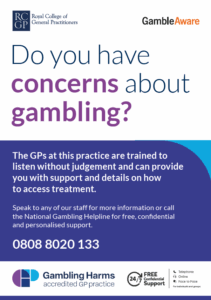
This means that as a surgery we are committed to improving support for patients experiencing gambling harms.
The GPs at this practice are trained to listen without judgement and can provide you with support and details on how to access treatment. Speak to any of our staff for more information or call the National Gambling Helpline for free, confidential and personalised support. 0808 8020 133
PIP Applications Housing Support
Please be aware that our clinicians do not write supporting letters to the DWP for PIP claims.
Instead, the DWP will send us a form to complete once you have applied for PIP, or applied for renewal of your PIP.
Your named GP will complete the form with the specific information they require. This helps to prevent over-divulging information to the DWP which may not be relevant to your claim.
The application pack for PIP clearly states that you DO NOT require a letter from the GP.
Once we receive the request from the DWP it will be completed within 28 days by your named GP.
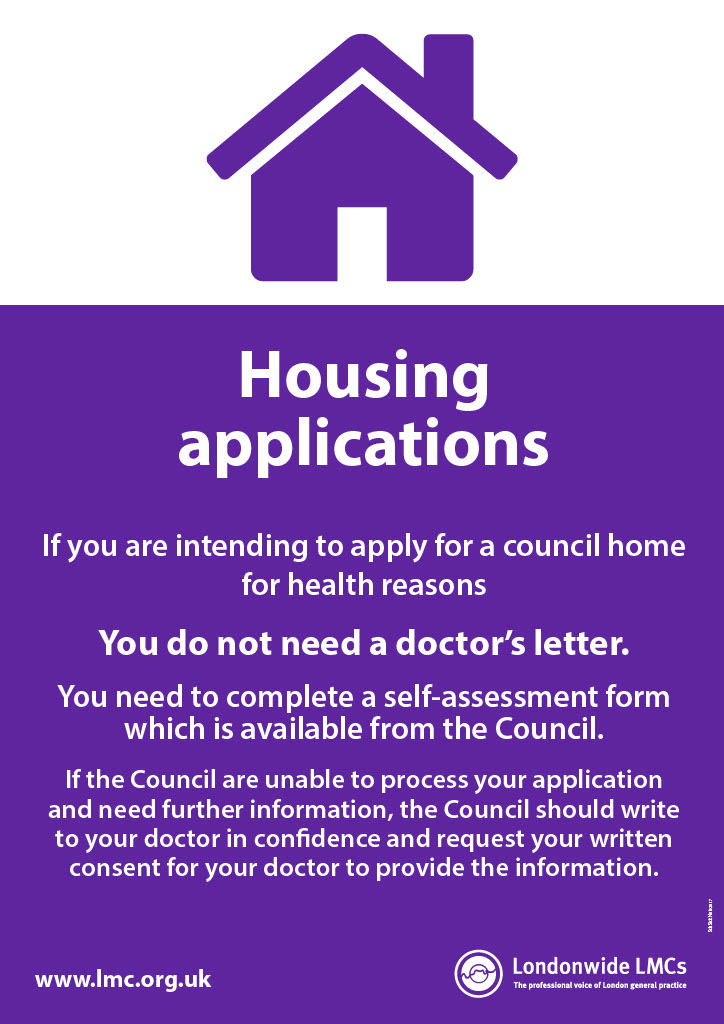
Housing Support
Please be aware that our clinicians do not write supporting letters to the council for housing support.
We ask patients to submit changes with the council/housing officer and should they require more information they will write to us directly.
In Times of Bereavement
In the unfortunate event that a person has passed away, there are three things that must be done in the first few days;
- Get a medical certificate from your GP or hospital doctor (this is necessary to register the death)
- Register the death within 5 days (8 days in Scotland). You will then receive the necessary documents for the funeral.
- Make the necessary funeral arrangements.
Register the death
If the death has been reported to the coroner (or Procurator Fiscal in Scotland) they must give permission before registering the death.
You can register the death if you are a relative, a witness to the death, a hospital administrator or the person making the arrangements with the funeral directors.
You can use the ‘Register a Death’ page on the gov.uk website that will guide you through the process. This will also explain the registration process for Scotland and Northern Ireland.
Arrange the funeral
The funeral can usually only take place after the death is registered. Most people use a funeral director, though you can arrange a funeral yourself.
Funeral directors
Choose a funeral director who’s a member of one of the following:
These organisations have codes of practice – they must give you a price list when asked.
Some local councils run their own funeral services, for example for non-religious burials. The British Humanist Association can also help with non-religious funerals.
Arranging the funeral yourself
Contact the Cemeteries and Crematorium Department of your local council to arrange a funeral yourself.
Funeral costs
Funeral costs can include:
- funeral director fees
- things the funeral director pays for on your behalf (called ‘disbursements’ or ‘third-party costs’), for example, crematorium or cemetery fees, or a newspaper announcement about the death
- local authority burial or cremation fees
Funeral directors may list all these costs in their quotes.
Macmillan are doing whatever it takes to help more people with cancer get the best care the UK has to offer, whoever and wherever they are.
Kooth
Kooth is an anonymous site which offers emotional and mental health support for children and young people aged between 11 and 24. On Kooth, qualified counsellors are online seven days a week to provide young people using the service with online counselling, through chat-based messaging via drop-in or booked sessions, which helps children and young people to feel safe and confident in exploring their concerns and seeking professional support. Kooth.com is an online application removing the need for Apple/Android accounts, data requirements and the stigma of mental health apps on your devices.
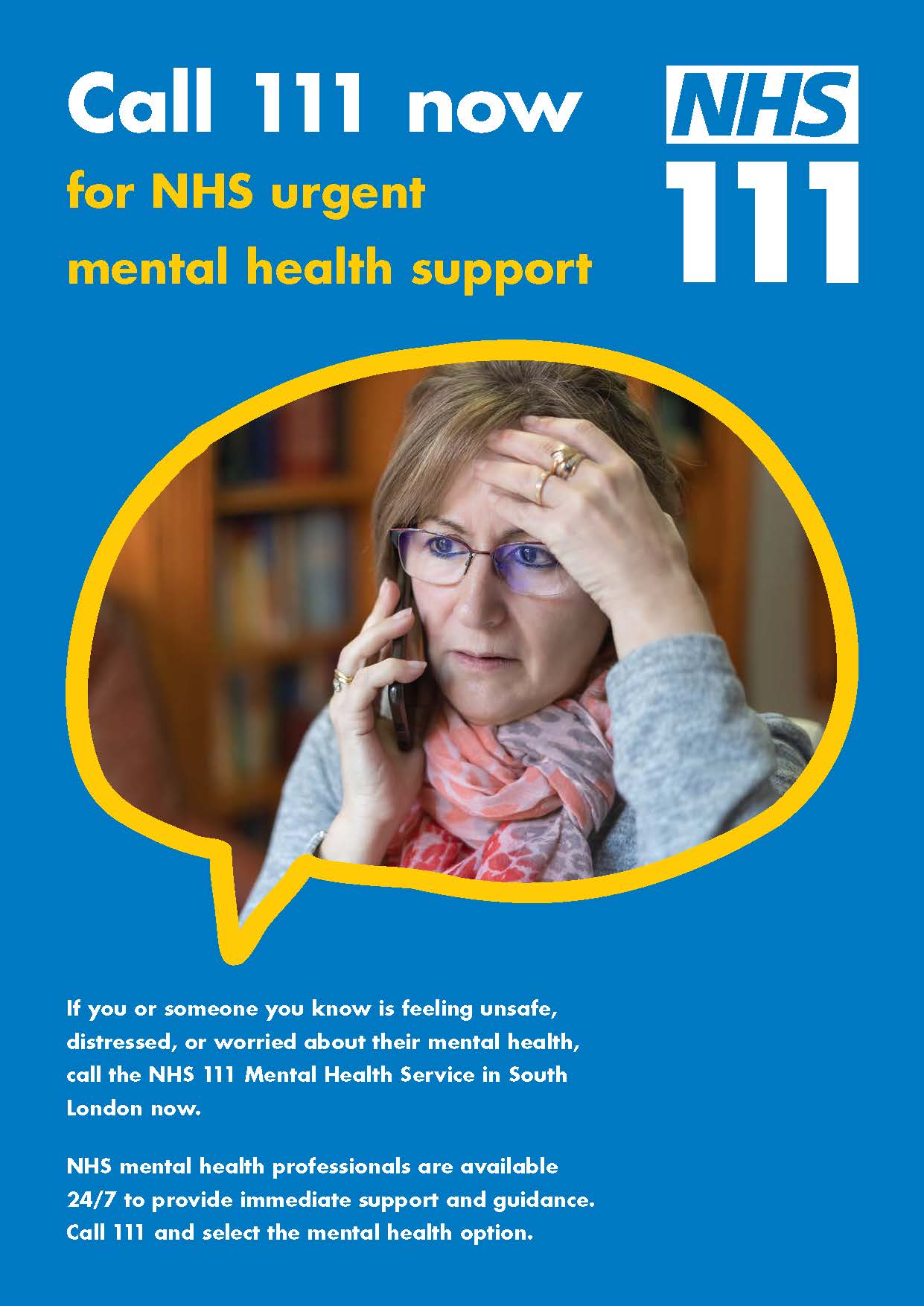
Mental Health Support in South West London
Looking for mental health support?
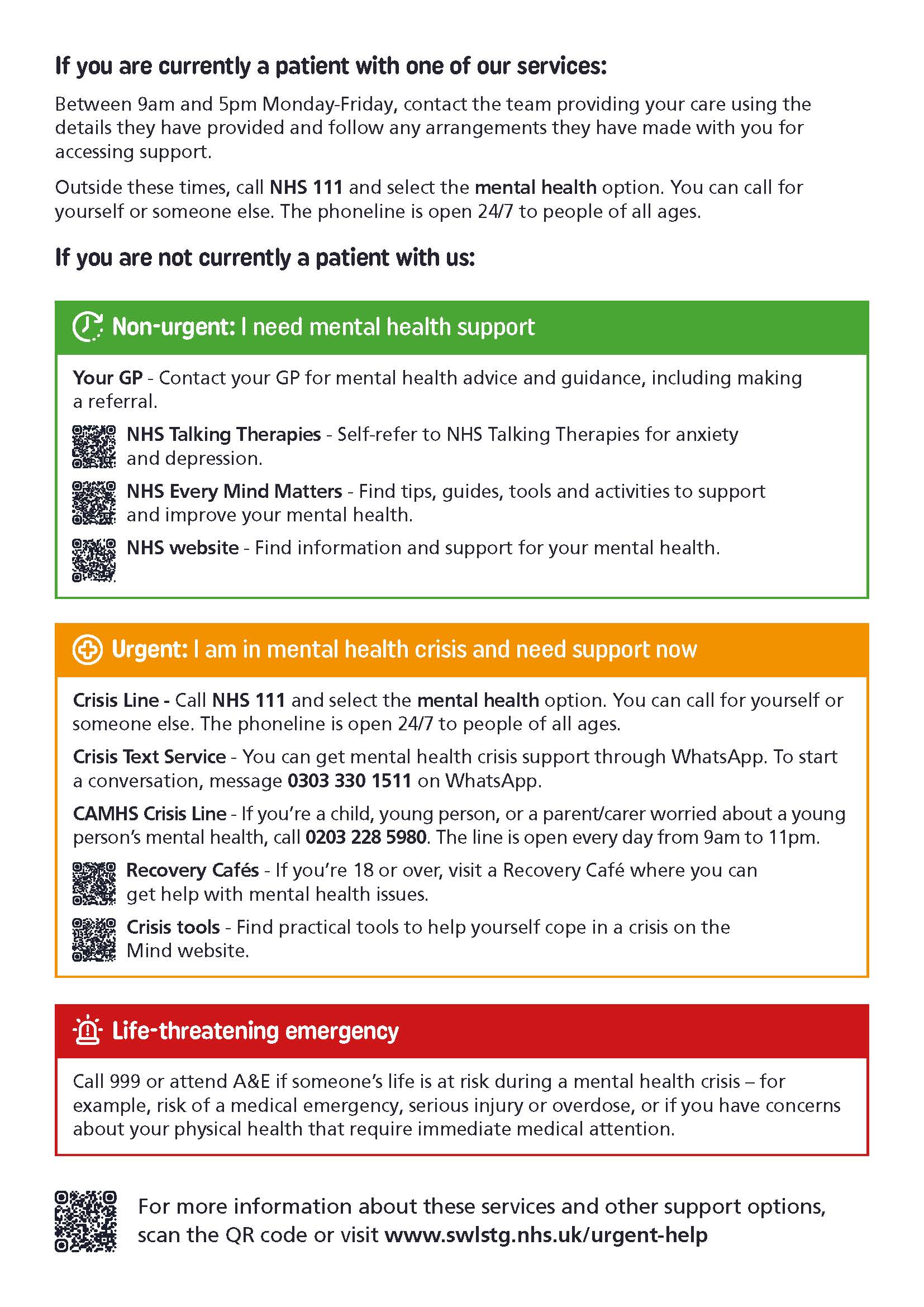
There are a range of services available to support you or someone you care about with their mental health. Whether you need general advice and support, help with anxiety or depression, or more urgent support during a mental health crisis, there are services available across South West London.
Please see the poster for more information for full details or the services and support available in South West London, including what to do if you need urgent help.
The poster also includes links and QR codes to further information and support:
Screening is a way of finding out if people have a higher chance of having a health problem, so that early treatment can be offered or information given to help them make informed decisions. This page gives an overview of screening, with links to the different types of screening offered by the NHS in England.
The more you know about your pregnancy and your options, the more you are likely to feel in control. The information given here is based on The Pregnancy Book, which your midwife should give you at your first appointment.
Self Refer Online
To St Georges
https://www.stgeorges.nhs.uk/pregnancy-referral-form/
To Chelsea & Westminster
https://www.chelwest.nhs.uk/services/maternity/self-refer-online/maternity-self-referral
Your pregnancy and labour
You and your baby
British Pregnancy Advisory Service
There is a new Central NHS Computer System called the Summary Care Record (SCR). It is an electronic record which contains information about the medicines you take, allergies you suffer from and any bad reactions to medicines you have had.
Why do I need a Summary Care Record?
Storing information in one place makes it easier for healthcare staff to treat you in an emergency, or when your GP practice is closed.
This information could make a difference to how a doctor decides to care for you, for example which medicines they choose to prescribe for you.
Who can see it?
Only healthcare staff involved in your care can see your Summary Care Record.
How do I know if I have one?
Over half of the population of England now have a Summary Care Record. You can find out whether Summary Care Records have come to your area by looking at our interactive map or by asking your GP
Do I have to have one?
No, it is not compulsory. If you choose to opt out of the scheme, then you will need to complete a form and bring it along to the surgery. You can use the form at the foot of this page.
Watch our introduction video on Total Triage here
Dear Chatfield Patients,
As part of our mission to improve the way in which we deliver care and improve our services, Chatfield Health Care has reviewed patient feedback and has launched our new Total Triage service. This will simplify the process to submit medical and admin requests, and patients will no longer be required to create an account.
This is a national NHS project and all general practices must adopt the Total Triage system by 31st March 2025.
Total Triage has been built by NHS GPs for NHS patients, designed to enhance patient access, improve practice efficiencies and signpost patients to the right place at the right time for their care.
What is Total Triage?
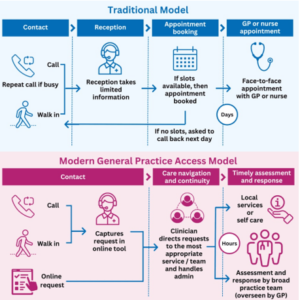
Total triage is a General Practice system where every patient contacting a practice first provides some information on the reasons for contact and is triaged before making an appointment.
All patient requests will be triaged by one of our experienced clinicians who will decide what the best course of action is. Where necessary, we might ask you to answer a few additional questions to help our doctor prioritise those patients who need more urgent care.
You could be given a face to face or telephone appointment, you could have a reply from the GP with self-care advice or you could be signposted to a more appropriate service.
The main purpose of the Total Triage model is to:
• Enhance the quality of care our patients receive.
• Ensure they are given the most appropriate appointment or advice to meet their needs.
• Communicate with patients in a timely way.
• Reduce health inequalities amongst patients.
How does it work?
All patients need to submit their request via the surgery’s website by clicking on the Contact Us Online image.
Ideally, patients will submit their own request however we appreciate that this may not be possible for some patients. If you are unable to use or access the online form then please contact the surgery in the usual way and we will complete the request for you, which will be added to the triage list to be reviewed by the clinician.
After the clinician has reviewed your request you will be offered the most appropriate appointment or guidance. This could be a same day appointment, a self-booking link or it might be a message with advice from the clinician.
Please note that in order for the clinician to triage your request in a timely manner it is very important to provide detailed and accurate information.
For instance if you have a cough it would be much easier for the GP to triage the request with the following information: ‘I had a cough for 10 days. I have already used over the counter medicine, but it is not helping and in the last couple of days my cough has been worsening and it feels more chesty. I also have a high temperature.’
If the information given is less detailed, such as ‘I had a cough for 10 days’, it makes it harder for the GP to triage and we will need more information.
The Total Triage service will be open Monday to Friday. You will not be able to send your GP a Total Triage form over the weekend, when you should instead contact the NHS 111 service. NHS 111 will put you in touch with the out of hours doctor if your problem needs GP assistance over the weekend.
How does this benefit you?
We know that change can be difficult sometimes, but we are confident that Total Triage will bring many benefits to our patients – for example:
• Total Triage has been shown to reduce waiting times and it enables us to attend to your medical needs more promptly.
• Using digital communication will mean that you can engage with us from the comfort of your home or workplace.
• Total Triage ensures that limited healthcare resources are allocated to patients who need them most urgently.
• Total Triage will address the increasing demand for appointments and reduce the frustration of having to call and be in a long queue at 8am.
• Using Total Triage means that all of our patient’s admin and medical requests can be assessed in the same way which will reduce inequalities.
You’ll wonder how you did without it!
• You may not need a trip to the surgery and your query may be resolved with a phone call.
• Triage ensures that limited healthcare resources are allocated to patients who need them most urgently.
• By prioritising patient, triage reduces waiting times for those with urgent medical needs. Patients receive timely care, leading to better outcomes.
• Improved patient safety as triage helps to identify high risk patients early, allowing healthcare providers to intervene promptly. This prevents complications and reduces the risk for adverse events.
• Total Triage streamlines the patient flow within the practice and makes the process more organised and efficient.
• You can check health symptoms online and receive on the spot medical advice and treatment guidance thanks to NHS content.
• Access wherever and whenever you want from any device without requiring a log in. Unlike a telephone call, you can complete a Total Triage form at a pace that suits you.
• You can request sick notes and test results and the clinician will advise if you need an appointment. Saving you time.
Frequently Asked Questions
• Will I get an appointment quicker if I speak to reception instead?
Our reception team will no longer be making GP appointments with patients directly. All requests will be passed through the triaging GPs, so if you are able to complete the online form yourself, this will be the most efficient way to request an appointment and, keep the phone lines clear for those that do not have internet access.
• What happens after I submit a query for a medical issue to the practice?
Medical queries will be submitted to our GP-led triage team. A member of the team will respond to you within 2 working days. Conditions that need to be assessed on the same day will be prioritised. The triage team may send you a request for further information in the form of a short questionnaire specific to your issue.
• What happens if I need an urgent appointment?
We will continue to have a duty doctor every day to deal with emergencies. Conditions that require a same day assessment will be booked in on that day or directed to an appropriate service. A member of our Patient Services Team will contact you directly to arrange an appointment after your form has been triaged by a GP. If you have any urgent medical complaint after 4pm please call the Surgery directly to be assessed.
• What happens after I submit a query for a medical issue to the practice?
Medical queries will be submitted to our GP-led triage team. A member of the team will respond to you within 2 working days. Conditions that need to be assessed on the same day will be prioritised. The triage team may send you a request for further information in the form of a short questionnaire specific to your issue.
• What if I do not have access to the internet or struggle to complete forms?
Our practice phone lines will remain open for anyone with accessibility needs who might find it difficult to complete this form and we will of course provide additional support to those patients who are unable to use online resources or have accessibility needs. Our team is here to guide and support all patients every step of the way.
• What if I have more than one medical issue that I need help with?
Please only submit one medical issue per appointment request form, so that you can add sufficient detail for each problem, which will allow our GPs to appropriately deal with your request.
• How do I submit an admin query?
There is an option to submit an admin query on the online form for general administrative issues such as requesting a letter from a doctor and fit notes. A member of the reception team will respond to you within 2 working days.
• What is self-book?
Our team may send you a text message, containing a self-booking link, inviting you to book your own appointment online. Please be advised these links stay live until you book the appointment for up to 7 days.
• Can I choose which clinician I see?
There is an option to specify which clinician you would like to see. We will try to meet this request and when using our self-booking link you will be able to select a specific GP availability permitting.
• Do I need to fill in the form at 8am?
Patient requests are triaged throughout the day by a clinician so you do not need to complete the request at 8am as all requests are triaged the on the same day.
• Can I fill in one form for more than one patient or for the whole family?
No, unfortunately requests for patients must be submitted separately. We have a duty of care to maintain confidentiality and that all requests are triaged appropriately.
We hope to support patients and their families/carers to get used to the new way of contacting the practice and to become comfortable with this over time.
Thank you for working together with us to improve our patient access and for your continued support. We welcome your feedback and ideas moving forward.
Childhood and Baby Immunisation
St John Therapy Centre, 162 St John Hill Battersea, London SW11 2SW
Tuesday – 3.00 pm to 6.00 pm
Wednesday 3.00 to 7.00 pm
Helpline 020 8812 6090
Balham Health Centre, 120 Bedford Hill, London SW12 9HS
Saturday 9.00 am to 12 noon
BCG Clinics held at St John Therapy Centre – Wednesday 11.00 am to 7.00 pm
Wandsworth Carers’ Centre has free services to support unpaid Carers in their caring role and to help them to have a life outside of caring – e.g information and advice, benefits checks, peer support groups, counselling, complementary therapies, back care and lots more.
For more information call: 020 8877 1200
email: info@wandsworthcarers.org.uk
Visit: www.carerswandsworth.org.uk
Wandsworth Wellbeing Hub
Not sure where to go for help?
The wellbeing Hub can put you in touch with organisations, self-help groupgs and activities available in the locum community
Find out more by calling 020 8812 6700 or visit www.wandsworthccg.nhs.uk/hub
General
Major long-term illnesses
- Asthma UK
- British Heart Foundation
- British Lung Foundation
- Cancer Research UK
- Macmillan Cancer Support
- Coeliac UK
- Diabetes UK
- Parkinsons’ Disease Society
Mental Health
Pregnancy
Travel Immunisations Advice
Welfare and General Wellbeing
We run a walk-in blood test clinic every Wednesday from 8:00am to 12:00pm.
You do not need an appointment to attend this clinic.
When you arrive, please check in at reception and inform the receptionist that you are here for a blood test. The receptionist will then book you in and you will be seen as soon as possible.
Wandsworth Talking Therapies provides free confidential psychological and wellbeing interventions for common mental health problems (anxiety disorders or depression).
Referrals are accepted from people aged 18 years and over who are Wandsworth residents, or non-Wandsworth residents who are registered with a Wandsworth GP. This includes those in temporary accommodation in the borough.